Ryan Murray | Co-Owner | Chief Editor | Contributor | Photographer
r.m.music84@gmail.com
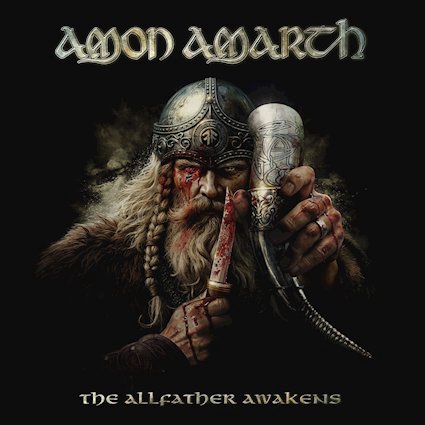
There are bands you listen to because they release good albums, and then there are bands whose records feel like an event. Amon Amarth have lived in that second category for a long time, but The Allfather Awakens somehow manages to make their 13th album feel like another charge into battle rather than another lap around familiar territory. Thirty-four years into their existence, the Swedish melodic death metal giants have delivered a record that sounds massive, immediate, ridiculously catchy and, most importantly, completely alive.
That last part matters. Amon Amarth have never been a band afraid of their identity. You know the riffs. You know Johan Hegg’s unmistakable roar. You know the enormous choruses, the Norse mythology, the war drums, the axes, the longships and the inevitable moment when thousands of people collectively decide that sitting down on a concert floor and pretending to row a Viking ship is somehow the most metal thing imaginable. Yet The Allfather Awakens doesn’t feel like Amon Amarth going through the motions. It feels like five musicians who know exactly what they are capable of and decided to push those strengths until the walls started shaking.
The difference begins with how this album was written. Instead of disappearing from the road and waiting for inspiration to arrive in a rehearsal room, Amon Amarth started writing while they were touring. The songs came together across two recording sessions, months apart, with the final recording completed in March 2026 at Jacob Hansen’s studio in Denmark. More importantly, the band attacked the album one song at a time, refusing to move forward until each track was finished. That approach is all over this record. There is an almost obsessive attention to the individual songs, but somehow the finished album still feels like one enormous beast.
And that beast comes out swinging.
Gjallarhorn is exactly the kind of opening statement you want from Amon Amarth, with a guitar riff that comes charging through the gates and a swagger that makes it almost impossible to sit still. Hegg sounds like he has personally arrived to announce the end of civilization, while the high tempo and ridiculously catchy chorus immediately establish the album’s ability to balance brute force with melody. It feels like a future live classic before the first chorus has even finished. Eight Legs of Thunder keeps that momentum rolling with a galloping rhythm that inspired Johan Söderberg to imagine Sleipnir, Odin’s eight-legged horse, turning the entire song into something that feels like a cavalry charge translated into guitar riffs. There is nothing subtle about it, and thank every god in Valhalla for that.
That same forward motion carries into Kvasir’s Blood and We Rule the Waves, where Amon Amarth continue doing what they do better than almost anyone else in metal. Their mythology never feels like homework because the band understands that these stories work best when they are treated as stories of blood, betrayal, sacrifice, violence and survival rather than dusty pieces of ancient history. Then “We Rule the Waves” takes that sense of adventure and blows it wide open with a chorus that practically demands an arena full of voices screaming it back. The lyrics reach toward the horizon, toward Vinland and beyond, and Hegg delivers them with the conviction of someone who has already seen the shoreline and is daring everyone else to follow.
Then Amon Amarth do something they have never done before.
They give us Upphaf.
An acoustic Amon Amarth song should, on paper, sound like the sort of thing that could go horribly wrong. Instead, it becomes one of the album’s most interesting moments. Taken from a translated stanza of Völuspá, the song strips away the distortion and lets melody, acoustic instrumentation and haunting choir work carry the weight. It is beautiful without becoming precious, atmospheric without dragging the album to a halt, and unmistakably Amon Amarth despite sounding like nothing they have released before. That may actually be the biggest surprise on The Allfather Awakens. The band have not reinvented themselves, and they didn’t need to. They have simply found new rooms inside a house they already built.
When the distortion returns, it hits even harder. Die With a War Cry brings back the muscular aggression with a rallying cry about facing destruction and mastering your own mind, and there is a motivational quality buried underneath all the death, war and fire that has always made Amon Amarth strangely uplifting. They can sing about annihilation and somehow make you feel like you could run through a brick wall afterward. Raven God digs further into that mythological territory, while The Allfather Awakes finally gives the album its title. Interestingly, it was the final composition written for the record, which almost feels appropriate. After everything that comes before it, the Allfather finally rises and the album feels like it has reached the summit of the mountain it has been climbing since the opening riff.
There is plenty of darkness here, but there is also an enormous amount of movement. The guitars have a slightly different character this time around, too. Amon Amarth deliberately stepped away from the more modern 5150 approach and returned to Marshalls, and that choice pays off. There is a rawer edge to the guitar work that gives the riffs a little more room to breathe while preserving the enormous melodic attack that has defined the band for decades. It is a subtle change on paper, but across the album it helps the guitars feel a little less polished and a little more dangerous.
That danger carries straight through Oden’s Hunt before Ascending Like an Eagle brings the album to a close. The latter carries an especially cool piece of history with it, serving as a continuation of Serpent’s Trail from The Great Heathen Army. Rather than feeling like an unnecessary sequel, it works as another chapter in the band’s ongoing mythology, built around persistence, overcoming obstacles and refusing to stay down. By the time the final notes disappear, the album has managed to cover an impressive amount of ground without ever losing sight of what makes Amon Amarth Amon Amarth.
That idea may actually be the beating heart of The Allfather Awakens.
Amon Amarth have been doing this for more than three decades. They have played tiny rooms, enormous festivals, legendary venues and stages in front of crowds that could swallow entire cities. They have shared bills with Pantera and Slayer, conquered Wacken, turned Bloodstock into a Viking longship and helped transform the audience “row” into one of the most recognizable rituals in modern metal. They have achieved the kind of mainstream recognition that many extreme metal bands spend their entire careers chasing without sanding away the edges that made people care in the first place.
And somehow, they still sound hungry.
That is what makes this album work so damn well. There is no desperation here. No desperate attempt to prove that Amon Amarth can still be heavy, no unnecessary genre detour and no awkward attempt to chase whatever happens to be fashionable in metal this week. The Allfather Awakens sounds like Amon Amarth knowing exactly who they are, then finding new ways to make that identity hit harder.
The production gives the riffs room to breathe. The melodies stick around long after the songs end. Hegg sounds commanding as ever, while Mikkonen and Söderberg continue to prove that Amon Amarth’s guitar work has always been about far more than simply being heavy. Lundström and Wallgren keep the whole machine moving underneath them, giving the album the kind of rhythmic backbone that makes even the quieter moments feel like they are building toward something.
And then there is the live question.
Good luck standing still when these songs hit the stage.
Amon Amarth have already announced that the new album will arrive with an entirely new production inspired by Odin’s Golden Hall, and after hearing The Allfather Awakens, it is almost impossible not to start imagining what these songs are going to sound like with thousands of people screaming them back. “Gjallarhorn” is practically begging for a sea of raised fists. “We Rule the Waves” could become absolutely monstrous in an arena, while “Upphaf” may provide the unexpected moment of stillness before everything explodes again.
That contrast is important. Because for all the fire, blood and thunder surrounding this band, The Allfather Awakens knows when to pull back. It knows when a melody needs space, when a chorus needs to be huge, when a riff needs to gallop and when a song needs to simply breathe.
Most importantly, it sounds like a band that still gives a damn about making great songs. That should not be taken for granted after 13 albums.
The Allfather Awakens is enormous without becoming bloated, familiar without becoming predictable and unapologetically Amon Amarth without feeling like a copy of anything they have done before. It carries the weight of the band’s history, but it never gets trapped underneath it.
The Allfather has awakened.
VERDICT: 4.5/5
Via Metal Blade Records


Leave a comment